
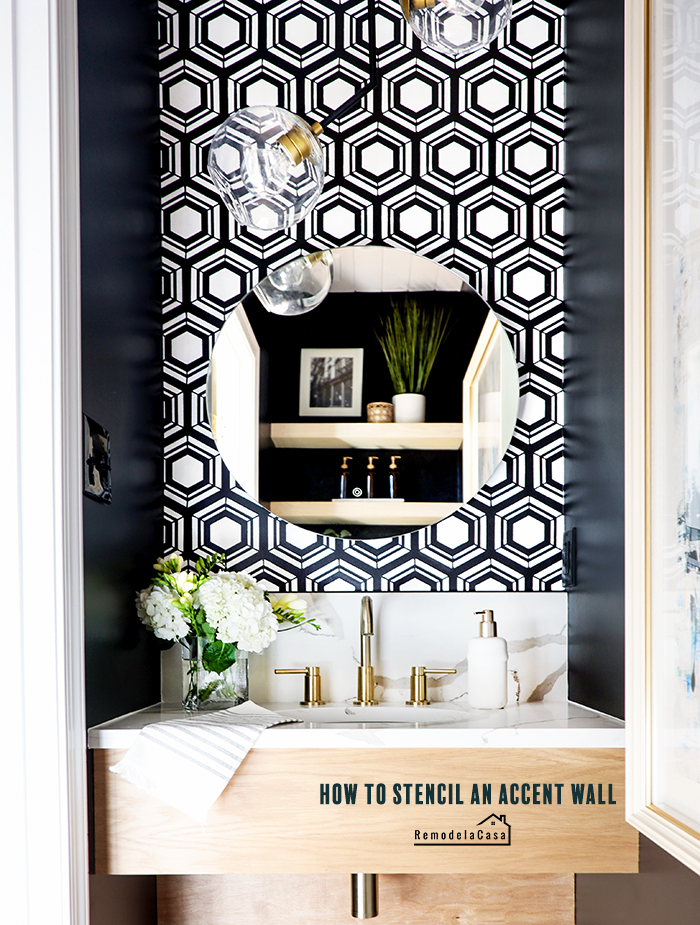
The makeover of our powder room was in its final stage. A planked ceiling was installed, a vanity was built, and the walls were patched and painted glossy black. It was time to give the vanity area a good style punch by stenciling a pretty hexagon allover design.
Wall stencils are a great way to give your room a fabulous pattern or design on a meager budget compared to alternatives like wallpaper or tile; that's precisely why I chose a stenciled accent wall.
*This post contains affiliate links for your convenience. Click here to read my full disclosure policy.
Let me tell you about my experience stenciling this hexagon design in our powder room, my mistakes, and the lessons I learned.




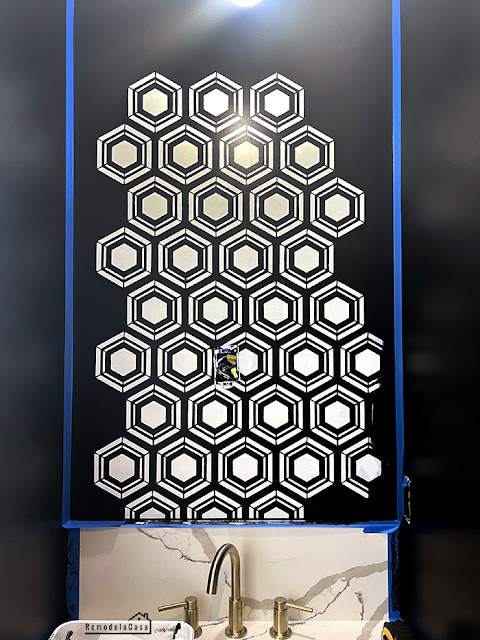



The last parts to be tackled were the four corners.
If you have never stenciled, the experts recommend avoiding geometric designs, high-contrast paint, and glossy paint.
Why?
An abstract is more forgiving than a geometric design when little mistakes happen, or the walls aren't that straight. The same concept applies to high-contrast & glossy paint treatments. Minor errors will be more visible when using those options.
I went against all those recommendations and still came up with a rather great-looking geometric design in this bathroom!
You can watch the video or continue reading below.
PREPARE THE WALL
Patch, prime, and paint the wall in your chosen color.
I painted the entire bathroom in Sherwin-Williams Tricorn Black in a satin finish. The sheen would help bounce light, making this small space appear larger. Again, it is better to use flat latex finish paints for general stenciling projects.
Mask off the other walls, ceiling, switch plates, etc., before you begin stenciling.

The tools & materials you'll need:
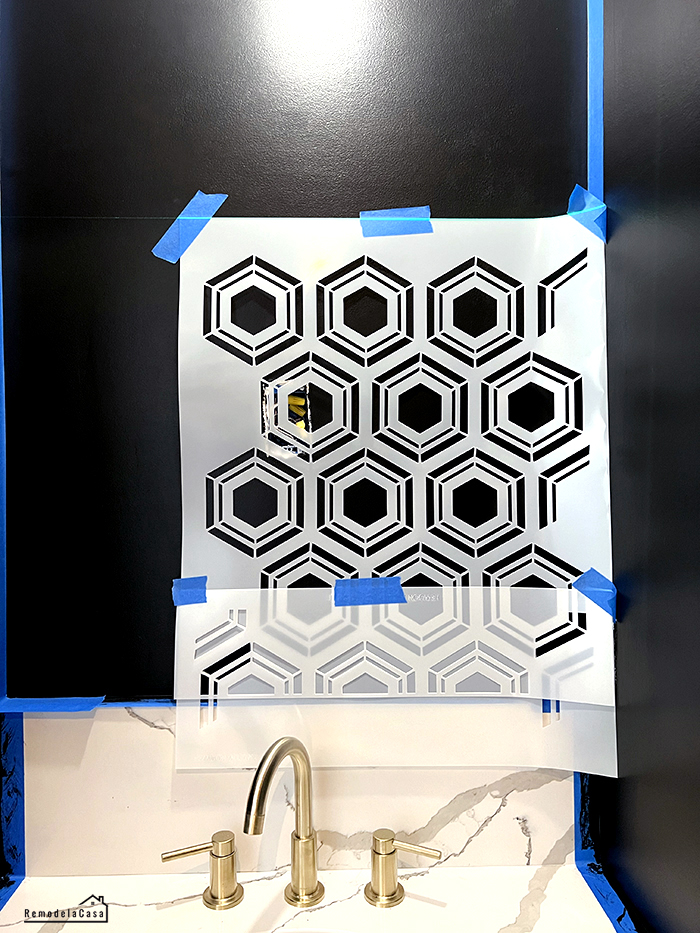
I used the Cutting Edge Stencils hexagon allover stencil, and I love that it comes with a free top and a single stencil. That single hexagon stencil made this entire project way easier to accomplish.
Easy-Tack adhesive was sprayed on the back of the main stencil to improve grip on the wall, easily reposition it, and prevent paint seepage.

DETERMINE THE STARTING POINT
A great variety of designs need to be centered on the wall; this hexagon design wasn't.
For this allover design, the main goal was to achieve symmetry on both sides of the wall.
Walls aren't straight; use a level to set the design on the wall. I used my laser level, which quickly set the horizontal and vertical lines.
The picture below shows my approach to ending the design on the lower part of the wall. The "top stencil" was positioned atop the main stencil as a guide for where to start/finish the design.

LESS IS MORE!
Regarding the amount of paint loaded on the roller, less is more. You need to load the high-density roller with paint, BUT you need to remove excess paint.
I rolled the excess paint onto an empty paper plate, then gave it a few passes with paper towels before applying it to the stencil.

PAINT THE DESIGN
Paint the design on the wall lightly, rolling the paint over the stencil.

Working those corners with this type of setup was a big no-no. I held the stencil with my free hand as I brought the roller closer to the corner, but it still wasn't close enough.
This is how it looked after two coats. By the way, those coats of paint are very light. The first part was already dry when I finished painting the last hexagon.

The stencil was repositioned. This time, I ensured it stayed off the corners. Those corners gave me a lot of trouble, but I finally figured out how to work with them.
Before going to that solution, I had to paint all those complete hexagons.

SHARPER PAINT LINES
Painting with a high-density roller went fast, but it didn't give me any razor-sharp lines. Maybe the roller was carrying too much paint?
It's possible. Even though I rolled it plenty of times on the paper towels, it was almost dry when I brought it to the wall.
At this point, I changed my strategy and started using stenciling brushes in a dry-brush technique. Once again, the brush had to be loaded, but you need to get rid of excess paint by dapping the brush onto paper towels.
Some people paint in a circular motion when using brushes. Instead, I used the stippling method, dabbing the brush onto the stencil openings.
Stippling sure takes longer, but the lines are very sharp. Using a bigger brush would've been even better.

A SINGLE STENCIL
Working with a large stencil on a small wall like this was a nuisance. I was so glad to have this single hexagon included with this design!
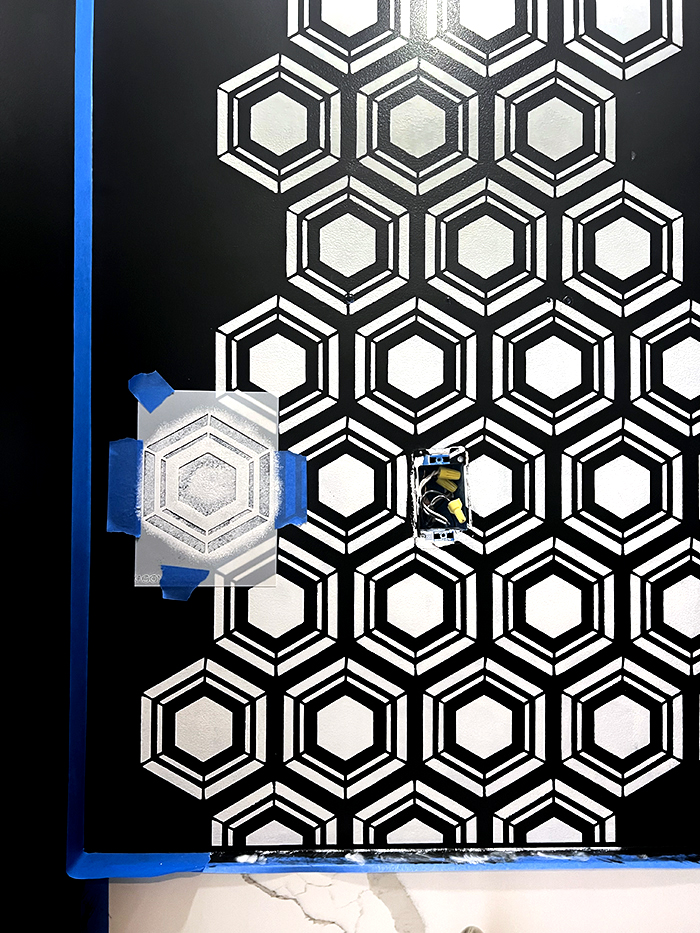
I first positioned this single stencil in the areas where the complete stencil had to be painted on the wall. It worked like a charm. So much easier for these areas closer to the corner.

TRIM YOUR STENCIL TO GET RIGHT INTO THOSE CORNERS
My solution to reaching those corners without trouble was to use a paper cutter to trim that single stencil as I went along.

You need to identify the most complete hexagons and trim the stencil to fit that wall area.
Again, painting the "complete hexagons" first and trimming gradually to reach the smaller sections. The trimmed stencil had to be flipped to use it on the right and left of the wall.

Instead of dealing with a humongous stencil that doesn't vent nicely, this was a phenomenal solution.

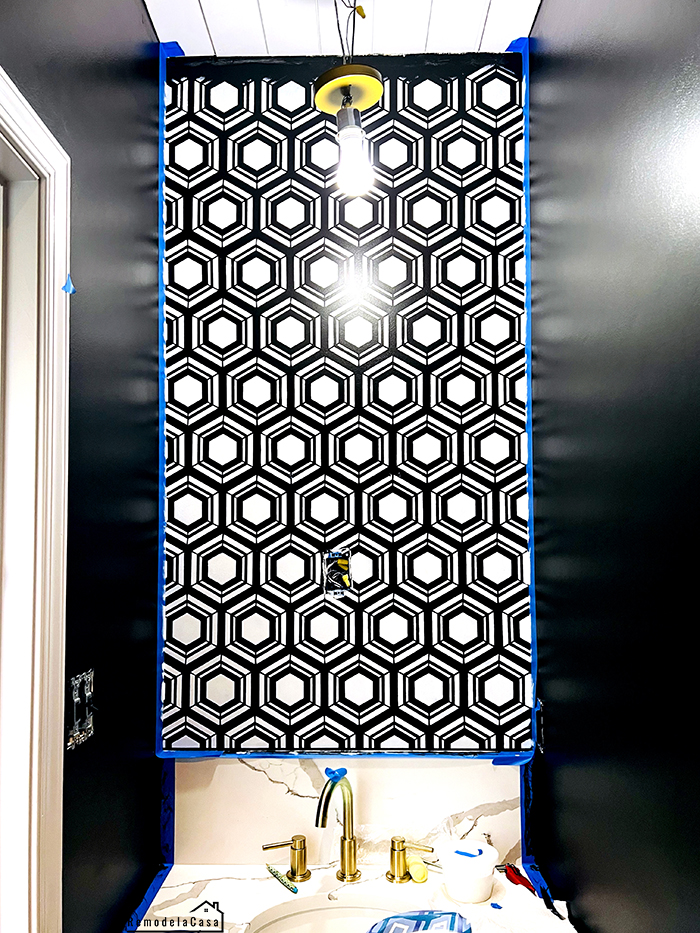


Here, almost done!
I had to go get the ladder to reach the top.

A new line of painter's tape was set opposite to create a crisp line on that backsplash.

You can see those little imperfections up close, but overall, I'm delighted with the result.

I love my new powder room!!
Check out all the projects tackled in this powder room makeover!
*This post contains affiliate links.


I absolutely love this! Makes me want to redo my powder room!!!!! Beautiful!
ReplyDeleteThanks Beck! Those tiny rooms are fun to redo.
DeleteI love the boldness! Great job on stenciling!
ReplyDeleteThanks so much, girly!!
Delete